Who Might Consider Third-Party Reproduction?
Third-party reproduction is the completion of a family-building plan through the assistance of participants other than the intended parents, who provide eggs, sperm, embryos, or pregnancy assistance.
Each family considers third-party reproduction for different reasons. Some face limitations regarding eggs, sperm, or uterine conditions; some need to reduce the risk of transmitting specific genetic diseases; and others are same-sex couples or single individuals who wish to build a family through appropriate reproductive arrangements.
Therefore, when determining whether third-party reproduction is suitable, you can start from "what kind of assistance is currently needed."
1. Decreased ovarian function or suboptimal egg quality
The quantity and quality of eggs are affected by age, ovarian function, past treatments, and personal health conditions.
A physician may recommend further understanding of egg donation under the following circumstances:
- significant decline in ovarian function
- advanced reproductive age
- Unable to obtain usable embryos after multiple egg retrievals
- Oocyte quality continues to affect embryonic development.
- premature ovarian failure or inability to produce eggs on one's own
- Past illnesses or treatments affect ovarian function
In its 2024 guidelines on donated gametes, the ASRM lists advanced reproductive age, diminished ovarian reserve, and hypergonadotropic hypogonadism as situations in which donated eggs may be used.
According to the CDC's 2022 US ART statistics,26.21 TP3T Treatment Protocol Report Includes Factors Related to Declining Ovarian Function. Since multiple causes can be reported for the same treatment cycle, this figure represents the proportion of cycles involving that factor and cannot be directly interpreted to mean that 26.2% of all patients require egg donation.Whether egg donation is appropriate requires a comprehensive assessment of age, ovarian reserve testing, previous egg retrieval results, embryo development, and the family’s expectations regarding genetic ties.
2. Inability to conceive naturally or at a higher risk of pregnancy.
Some individuals are able to create embryos, but due to physical conditions cannot carry a pregnancy themselves, or because pregnancy may pose higher health risks, they therefore consider assistance from a surrogate mother.
The medical indications for gestational surrogacy listed by ASRM include:
- congenital or acquired absence of the uterus
- severe or irreparable uterine abnormalities
- Pregnancy has clear medical contraindications.
- Pregnancy can worsen severe illnesses.
- Pregnancy may cause significant harm to the individual or the fetus.
The above situation needs to be clearly documented in the medical record and evaluated by a reproductive endocrinologist and relevant specialists.
For example, having previously undergone a hysterectomy, having irreversible uterine adhesions, or suffering from heart or lung disease where pregnancy would pose a significant risk, may require discussing alternative pregnancy arrangements.
Surrogacy involves medical, psychological, legal, and insurance procedures, and a single diagnosis does not automatically mean suitability for undergoing treatment.
3. Uterine factors affect embryo implantation or pregnancy
Uterine factors may affect embryo implantation, pregnancy maintenance, or obstetric safety. Situations requiring further evaluation may include:
- congenital uterine structural anomaly
- Severe intrauterine adhesions
- Recurrent pregnancy loss or miscarriage
- Uterine diseases or surgeries affect reproductive function.
- The medical team determined that it is inadvisable to conceive naturally.
According to CDC data, in the 2022 US ART cycles,6.01 TP3T Report on Uterine FactorsThe same treatment course can have multiple reasons simultaneously, so this percentage cannot be directly equated to the demand for surrogacy.
Doctors usually first use ultrasounds, hysteroscopy, imaging examinations, and medical history evaluations to determine whether there is still a possibility of treatment or natural pregnancy, and then discuss whether a surrogate mother is necessary.
4. Specific Genetic Disease Considerations
If prospective parents themselves have or carry specific genetic diseases, they can reduce the risk of transmitting the disease through genetic counseling, preimplantation genetic testing, egg donation, sperm donation, or embryo donation. Possible situations include:
- Known carrier of a severe genetic disorder
- I have a condition that can be passed down to the next generation.
- Family history of significant genetic disorders
- Existing tests still cannot clearly confirm the carrier status.
- Both parties carry the same recessive genetic disease
Genetic counseling should be received first to determine whether germ cell donation is necessary. Some families can manage this through embryo testing, while others may require egg or sperm donation, with the actual arrangement depending on the disease type, inheritance pattern, and testing capability.
5. Family-building needs of same-sex partners
Same-sex couples may need third-party involvement in their treatment due to a lack of eggs, sperm, or a uterus capable of carrying a pregnancy.
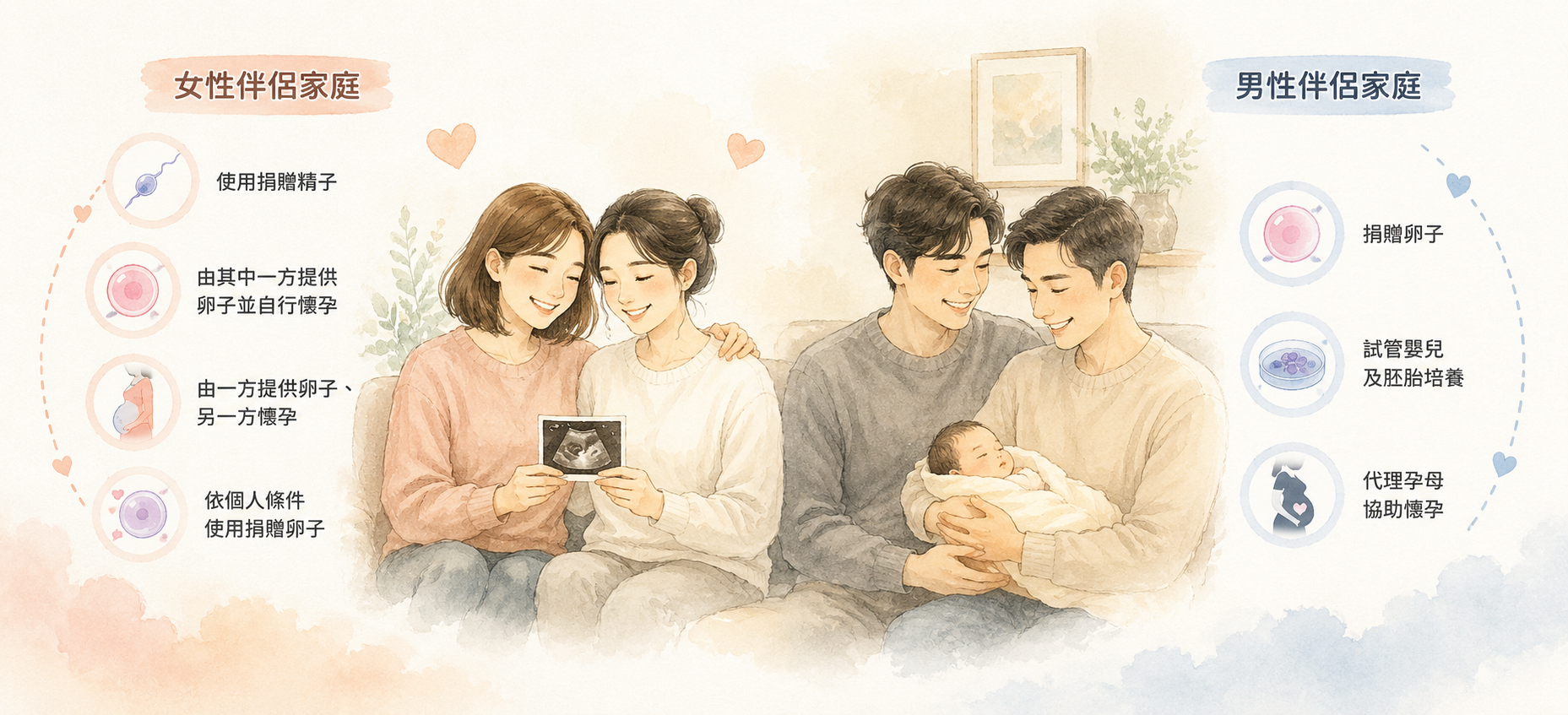
The treatment schedule also needs to consider whether both parties wish to have a genetic connection, the method of embryo creation, and the local legal regulations regarding parentage and third-party reproduction.
6. Fertility planning for singles
Single individuals can also plan a family through third-party reproduction. Depending on individual circumstances, they may use:

Besides medical conditions, single parenting planning also requires evaluating the parenting support system, financial preparation, future care arrangements, and legal procedures after the child is born.
7. Re-evaluating other options after multiple IVF cycles
Multiple failed IVF cycles can stem from various factors, including: This recommendation does not mean that surrogacy is necessary after multiple failed IVF cycles. The physician must still first evaluate the embryos, uterus, endometrium, immune system, and other potential factors.
- The number of retrieved eggs is limited.
- Fertilization or embryonic development status is not ideal
- Unable to retrieve suitable embryos for implantation
- Insufficient number of chromosomally normal embryos
- Uterine or endometrial factors
- Unconfirmed medical reason
At this point, the medical team may review past treatment records and then discuss:
- Whether to continue using one's own eggs or sperm
- Have you considered egg or sperm donation?
- Is it necessary to adjust the embryo testing and transfer strategy?
- Is there a need for a medical evaluation for a surrogate mother?
- Have you considered embryo donation?
This recommendation does not mean that surrogacy is necessary after multiple failed IVF attempts. Physicians still need to first evaluate the embryos, uterus, endometrium, immune status, and other potential factors.
One-minute summary
Families considering third-party reproduction may face different needs regarding eggs, sperm, embryos, uteruses, pregnancy safety, or family composition.
Suitable paths may include sperm donation, egg donation, embryo donation, surrogacy, or other medical procedures. After clarifying the needs, reproductive specialists, genetic counselors, mental health professionals, and reproductive lawyers will jointly evaluate the case to establish a more comprehensive treatment plan.
Website article data source
- American Society for Reproductive Medicine, Gamete and Embryo Donation Guidance, 2024.
- American Society for Reproductive Medicine, Recommendations for Practices Using Gestational Carriers: A Committee Opinion, 2022.
- U.S. Centers for Disease Control and Prevention, National ART Summary, 2022.
- U.S. Centers for Disease Control and Prevention, ART Surveillance